
AC Repair Birmingham AL: Spot Problems Before Bills Spike

A Birmingham air conditioner works harder than most. It removes heat and humidity from late April through October, often with July highs near 90°F and muggy nights that never cool off. That nonstop load wears down capacitors, clogs drain lines and exposes weak ductwork fast. Smart AC repair Birmingham AL homeowners can count on starts with one habit: catching small symptoms before they become a dead system on the hottest weekend of the year. This post shows you what fails, what it costs, how to troubleshoot safely and when replacement makes more sense than another repair.
Key Takeaways
- Humidity is the hidden workload. Up to a third of your AC’s effort in a Birmingham summer goes to pulling moisture out of the air, so a system that “cools but feels clammy” is already underperforming.
- The $15 fix comes first. A clogged filter or tripped float switch causes a large share of no-cool calls. Check those before booking a diagnostic.
- The 5,000 rule sets your budget. Multiply the repair cost by the system’s age. If the result tops $5,000, replacement usually wins on long-term cost.
Why Birmingham Summers Stress AC Systems
Birmingham summers stress AC systems because heat and humidity arrive together and stay for months. Your unit removes moisture as well as heat, so it runs longer cycles than an identical unit in a dry climate. Long run times mean more wear on the compressor, more condensate in the drain pan and more dust loading on the filter.
Across the calls we field from Jefferson County, the pattern repeats every June. The first true heat wave exposes parts that were already weak in spring.
Local Conditions That Shorten AC Life
| Birmingham Condition | What It Does to Your AC | What Technicians Often Find |
|---|---|---|
| Long cooling season (late April to October) | More run hours per year than northern systems | Worn contactors and capacitors by year 8 to 10 |
| High summer humidity | Heavy condensate production | Algae-clogged drain lines and wet float switches |
| Pollen season (spring) | Coats the outdoor coil and filter | Restricted airflow and high head pressure |
| Red clay soil and hillside lots | Settling pads tilt outdoor units | Strained refrigerant lines and noisy fans |
| Older homes (Southside, Forest Park, Crestwood) | Patched or leaky ductwork | Warm upstairs rooms and long cycles |
| Summer thunderstorms | Power surges and outages | Fried control boards and failed capacitors |
| Attic air handlers | Attic temps can top 130°F | Overheated blower motors and sweating ducts |
If you’ve spent a summer in Birmingham, you know the AC never really gets a day off. That is why preventive attention pays off here more than almost anywhere.
Your next step: note your system’s age from the data plate on the outdoor unit. You will need it for the repair vs. replace math below.
The Most Common AC Failure Points
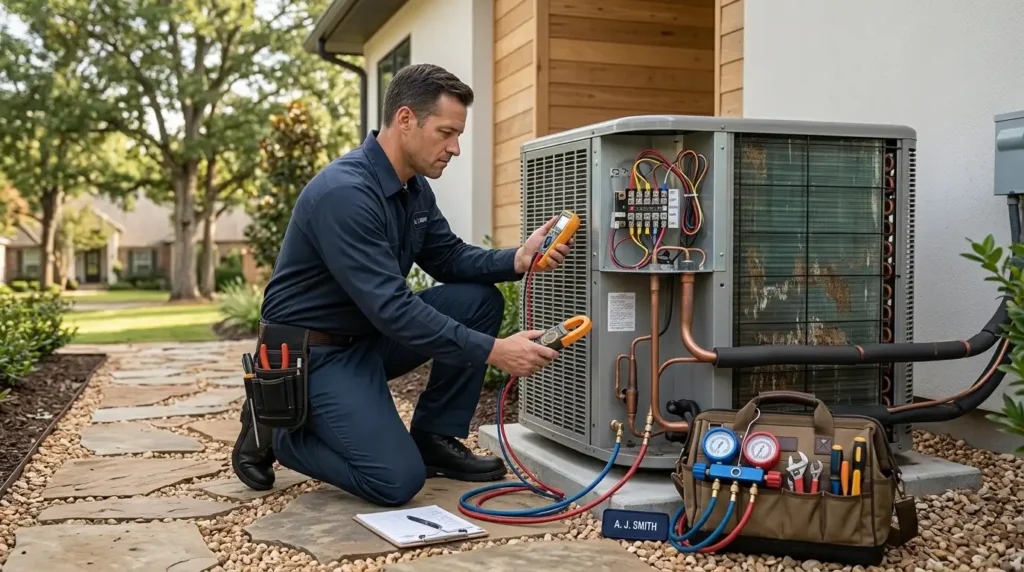
Most AC failures trace back to a short list of parts. Technicians in our network find the same five culprits again and again: the run capacitor, the contactor, the condensate drain, the refrigerant circuit and the blower motor. Knowing the symptom for each helps you describe the problem clearly on the phone.
You can browse detailed walkthroughs for each symptom in our guides to common heating and cooling problems, including warm air at the vents and ice on the lines.
Common AC Problems: Symptoms, Causes and Actions
| Symptom | Likely Cause | Safe Homeowner Action | Needs a Pro? |
|---|---|---|---|
| Warm air from vents | Failed capacitor, outdoor fan stopped, low refrigerant | Confirm thermostat is on Cool, check breaker | Yes, if outdoor fan is not spinning |
| AC won’t turn on | Dead thermostat batteries, tripped breaker, float switch tripped | Replace batteries, reset breaker once, check drain pan | Yes, if breaker trips again |
| Ice on copper line or coil | Dirty filter, blocked return, low refrigerant | Turn system off, run fan only to thaw, replace filter | Yes, if ice returns |
| Water near indoor unit | Clogged condensate line, cracked pan | Shut off system, clear visible debris at drain outlet | Yes, for pan or pump issues |
| Humming but no start | Weak start/run capacitor | Turn off at thermostat to protect compressor | Yes, right away |
| Grinding or squealing | Worn fan motor bearings or belt | Turn system off | Yes |
| Clicking with no cooling | Bad contactor or control board | Note when clicks happen | Yes |
| Short cycling (on/off every few minutes) | Oversized unit, dirty coil, thermostat location | Check filter, confirm thermostat isn’t near a sunny window | Yes, if it continues |
| High bills, same comfort | Dirty coils, duct leaks, aging compressor | Replace filter, clear plants around outdoor unit | Yes, for coil cleaning or duct testing |
| Musty smell | Mold in drain pan or ducts | Change filter, check for standing water | Yes, for coil or duct cleaning |
A Note on Refrigerants
Refrigerant type affects repair cost. R-22 production ended in 2020, so recharging an older system is expensive and often not worth it. Systems from roughly 2010 to 2024 use R-410A, which is now being phased down under federal rules. New systems use lower-impact refrigerants such as R-454B or R-32.
Refrigerant never “gets used up.” If your system is low, it has a leak, and topping it off without a repair just delays the next call.
Step-by-Step Homeowner Troubleshooting Checklist

A five-minute check solves many no-cool calls. These steps are safe for any homeowner and require no tools. Never open the outdoor unit or air handler panels: they hold high voltage, charged capacitors and pressurized refrigerant.
- Check the thermostat. Set it to Cool, lower the setpoint 3°F below room temperature and replace the batteries if the screen is dim.
- Inspect the air filter. Hold it up to a light. If you can’t see light through it, replace it.
- Check the breakers. Look for tripped breakers labeled AC, condenser or air handler. Reset once only.
- Confirm the outdoor disconnect. The gray box near the condenser should be in the On position.
- Look at the drain pan. Standing water may have tripped the float switch, which shuts the system off to prevent leaks.
- Walk to the outdoor unit. Clear leaves, grass clippings and plants within 2 feet of the coil.
- Listen and watch. Note whether the outdoor fan spins, whether you hear humming and whether air at the vents feels cool.
- Open supply vents and returns. Closed or blocked vents restrict airflow and can freeze the coil.
Stop and Call If You Notice
- A burning or electrical smell
- A breaker that trips a second time
- Ice returning after a thaw
- A humming outdoor unit with a still fan
- Water leaking through a ceiling below an attic unit
Write down what you observed in steps 1 through 8. A technician can diagnose faster with those notes, which can shorten the visit.
Typical AC Repair Costs in the Birmingham Area
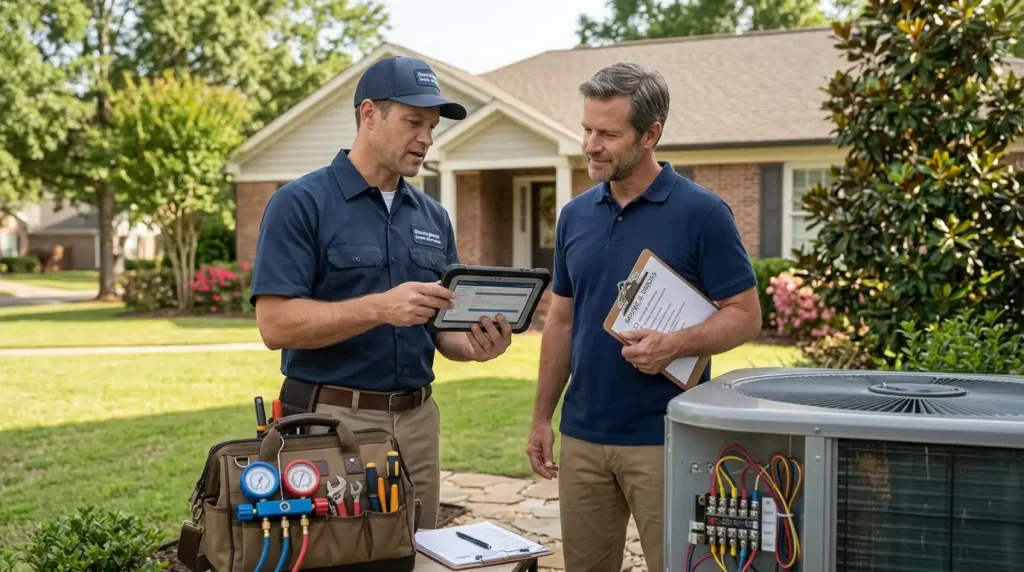
Repair costs depend on the part, the equipment brand and access. An attic air handler in a 1920s Highland Park home takes longer to reach than a closet unit in a new Chelsea subdivision. The ranges below reflect general 2026 market estimates for AC repair Birmingham AL homes, including parts and labor. Your provider sets actual pricing, so always ask for a written quote before work begins.
Estimated Repair Cost Ranges
| Repair | Typical Cost Range | Repair Time | Notes |
|---|---|---|---|
| Diagnostic visit | $75 to $150 | 30 to 60 min | Often credited toward the repair |
| Capacitor replacement | $150 to $400 | Under 1 hour | Most common summer repair |
| Contactor replacement | $150 to $350 | Under 1 hour | Often fails with capacitors |
| Condensate drain clearing | $100 to $250 | Under 1 hour | Common in humid months |
| Thermostat replacement | $150 to $500 | 1 hour | Smart models cost more |
| Condenser fan motor | $300 to $700 | 1 to 2 hours | Grinding noise is an early sign |
| Blower motor | $400 to $1,500 | 1 to 3 hours | ECM motors at the high end |
| Refrigerant leak repair | $200 to $1,500+ | 1 to 4 hours | Includes leak search and recharge |
| Evaporator coil | $1,200 to $2,800 | 4 to 8 hours | Warranty may cover the part |
| Compressor replacement | $1,800 to $4,000+ | 4 to 8 hours | Often triggers a replace decision |
| Emergency or after-hours fee | $100 to $300 added | Varies | Ask before the visit is booked |
Transparent pricing protects both sides. Ask three questions on every quote: Is the diagnostic fee credited? Is the part under manufacturer warranty? How long is the labor warranty?
Repair vs. Replace: A Decision Framework
The repair vs. replace decision comes down to age, cost and efficiency. No single birthday forces replacement. A well-maintained 14-year-old system with a failed capacitor deserves a repair. A 16-year-old R-22 system with a dead compressor does not.
The 5,000 Rule
Multiply the repair cost by the system’s age in years.
- Under $5,000: Repair is usually the smarter move.
- Over $5,000: Replacement usually delivers better long-term value.
Example: A $1,200 coil repair on an 11-year-old system equals $13,200. That points toward replacement.
Repair vs. Replace Comparison
| Factor | Lean Toward Repair | Lean Toward Replace |
|---|---|---|
| System age | Under 10 years | Over 12 to 15 years |
| Refrigerant | R-410A or newer | R-22 |
| Repair cost | Under 25% of replacement cost | Over 40 to 50% of replacement cost |
| Repair history | First major repair | Third repair in two summers |
| Energy bills | Stable year over year | Rising with no rate change |
| Comfort | Even temperatures | Hot rooms, high humidity indoors |
| Efficiency | 14+ SEER | 10 SEER or lower |
| Warranty | Parts still covered | Warranty expired |
Typical Equipment Lifespans in Central Alabama
| Equipment | Average Lifespan Here | Why |
|---|---|---|
| Central AC condenser | 12 to 15 years | Long cooling season adds run hours |
| Heat pump | 10 to 15 years | Runs year-round for heating and cooling |
| Ductless mini-split | 15 to 20 years | Inverter compressors reduce wear |
| Gas furnace | 18 to 25 years | Light winter use |
| Air handler / blower | 15 to 20 years | Attic heat shortens the low end |
| Thermostat | 10+ years | Electronic failure or upgrade |
Pros and Cons of Replacing Now
Pros
- Lower monthly energy bills with higher SEER2 equipment
- Better humidity control with variable-speed systems
- New manufacturer warranty, often 10 years on parts
- Modern refrigerant with a supply future
Cons
- Higher upfront cost, often $6,000 to $12,000+ for a full split system
- Possible ductwork or electrical upgrades
- Installation takes 1 to 2 days
Your next step: run the 5,000 rule on any quote over $1,000 before you approve it.
SEER2 Efficiency Standards for Alabama Homes

SEER2 is the current federal efficiency rating for air conditioners and heat pumps. It replaced the older SEER test on January 1, 2023 with a method that better reflects real duct conditions. Alabama sits in the federal Southeast region, which carries a higher minimum than northern states.
The U.S. Department of Energy’s guide to home heating and cooling explains how efficiency upgrades lower energy use. Moving from a 9 or 10 SEER system to a modern unit can cut cooling energy use substantially.
Federal Minimums and ENERGY STAR Levels
| Equipment Type | Southeast Minimum (SEER2) | Old SEER Equivalent | ENERGY STAR Level (SEER2) |
|---|---|---|---|
| Split AC, under 45,000 BTU/h (under ~3.75 tons) | 14.3 | 15.0 | 15.2+ |
| Split AC, 45,000 BTU/h and up | 13.8 | 14.5 | 15.2+ |
| Split heat pump | 14.3 (HSPF2 7.5) | 15.0 | 15.2+ (HSPF2 7.8+) |
| Packaged AC or heat pump | 13.4 | 14.0 | 15.2+ |
What Efficiency Means for Your Bill
| Upgrade Path | Approximate Cooling Energy Savings |
|---|---|
| 10 SEER to 14.3 SEER2 | 25 to 30% |
| 10 SEER to 16 SEER2 | 35 to 40% |
| 13 SEER to 16 SEER2 | 15 to 20% |
| Single-stage to variable-speed | Better dehumidification plus added savings |
You can compare certified models through ENERGY STAR before you choose new equipment. In our humid climate, variable-speed systems often earn their cost back through comfort alone, since they run longer at low speed and pull more moisture from the air.
Ask any installer for a Manual J load calculation. A properly sized system matters as much as the SEER2 number.
Birmingham Service Area Coverage
Fast AC repair Birmingham AL families can rely on depends on reaching a provider who actually works your area. At HVAC Service Birmingham, one phone call connects homeowners with independent, local HVAC providers who serve their address. Coverage spans 23 towns and communities across four regions. See the full list on our Birmingham-area service coverage page.
Where Homeowners Can Get Connected
| Region | Towns and Communities | Local AC Notes |
|---|---|---|
| Jefferson County | Birmingham, Trussville, Gardendale, Fultondale, Pinson, Mount Olive | Older housing stock, attic units and aging ducts |
| Shelby County | Pelham, Alabaster, Chelsea, Clanton, Vandiver, Sterrett, Westover | Newer subdivisions, larger homes and two-zone systems |
| St. Clair County | Pell City, Leeds, Moody, Odenville, Springville, Riverside, Cropwell, Steele | Lake homes with humidity and corrosion concerns |
| North Alabama | Bremen, Moulton | Coverage confirmed on the call |
What We Hear Most by Area
- Trussville and Pinson: Short cycling in newer homes with oversized units
- Pelham and Alabaster: Clogged condensate lines in second-floor air handlers
- Downtown and Southside Birmingham: Duct leaks in older homes with patched systems
- Pell City and Logan Martin lake homes: Coil corrosion and high indoor humidity
Before any visit, ask the provider for their Alabama contractor license number and proof of insurance. The Alabama Board of Heating, Air Conditioning and Refrigeration Contractors offers license verification.
When to Call a Pro
Call a professional when the problem involves electricity, refrigerant or repeated failures. Homeowner checks stop at the filter, thermostat, breaker and outdoor debris. Anything beyond that needs trained hands and proper tools. The full range of repair, tune-up and replacement options is outlined on our residential HVAC services page.
Urgency Guide
| Situation | Urgency | What to Do |
|---|---|---|
| Burning smell, smoke or sparking | Emergency | Shut off power at the breaker, call immediately |
| No cooling, infants or elderly at home, 95°F+ day | Urgent | Call right away, move to a cool room or location |
| Humming outdoor unit, fan not spinning | Same day | Turn off at thermostat to protect compressor |
| Ice on lines after filter change | Within 24 hours | Run fan only, call for refrigerant check |
| Water leaking through ceiling | Same day | Shut system off, protect flooring |
| Higher bills, warm upstairs | Schedule soon | Book diagnostic and duct check |
| Strange noise, still cooling | Schedule soon | Note when the sound occurs |
Seasonal Maintenance Checklist
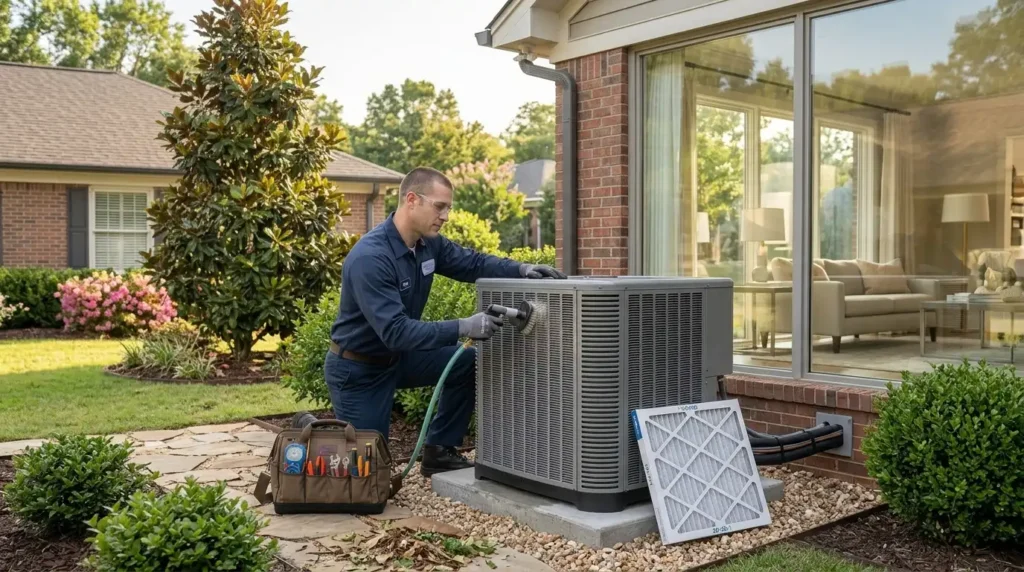
Spring (March to April)
- Replace the air filter
- Rinse pollen from the outdoor coil with a garden hose (power off)
- Pour 1 cup of white vinegar down the condensate line access
- Book a professional tune-up before the May rush
Summer (June to August)
- Check the filter every 30 days
- Keep 2 feet of clearance around the condenser
- Watch for water around the indoor unit
Fall (September to October)
- Replace the filter again
- Schedule a heating check for your furnace or heat pump
- Note any summer issues for the technician
Our network sees a clear trend: homes with two tune-ups per year call far less often during July heat waves. When something does go wrong, the HVAC Service Birmingham team can connect you with a local provider in one call. Have your address, system type and troubleshooting notes ready.
FAQs:
1. Why does my AC freeze up during Birmingham’s humid summer nights?
Freezing happens when the indoor coil drops below 32°F. Humid air adds extra moisture to the coil, so a dirty filter or low refrigerant turns that moisture into ice faster. Turn the system off, run the fan to thaw it and replace the filter. If ice returns, schedule AC repair Birmingham AL service for a refrigerant check.
2. Is it normal for my AC to run all day when it’s 95°F in Birmingham?
Yes, within limits. On extreme days, a properly sized system may run nearly nonstop and hold the house 15 to 20°F below the outdoor temperature. If your home won’t drop below 80°F in the evening, the system likely has an airflow, refrigerant or sizing problem.
3. How often should I change my filter during pollen season in Shelby County?
Check it every 30 days from March through May. Pollen loads filters quickly in Pelham, Alabaster and Chelsea, where tree cover is dense. Homes with pets or allergies may need monthly changes year-round.
4. Can a summer thunderstorm damage my air conditioner?
Yes. Power surges from storms often take out capacitors, contactors and control boards. A whole-home or HVAC-specific surge protector costs far less than a new board. If your AC stops after a storm, check the breaker once, then call.
5. Should I repair a 12-year-old AC in my older Birmingham home?
It depends on the repair and the refrigerant. A capacitor or contactor on an R-410A system is worth fixing. A compressor or coil failure on a 12-year-old unit often fails the 5,000 rule. Older homes also benefit from a duct inspection before any replacement.
6. Why are some rooms in my Trussville two-story home always hot?
Upstairs rooms gain heat from the roof and attic. Common causes include undersized return ducts, duct leaks and a single thermostat downstairs. Solutions range from duct balancing to a ductless mini-split or a zoned system.
7. How quickly can I get AC repair in Birmingham, AL during a heat wave?
Timing depends on provider availability, location and demand. July and August heat waves create the longest waits. Calling early in the day and having clear troubleshooting notes helps speed scheduling for AC repair in Birmingham, AL homes.
8. Does high indoor humidity mean my AC needs repair?
Not always, but it’s a warning sign. Indoor humidity should stay between 40 and 55%. Higher levels point to an oversized unit, a fan set to On instead of Auto, or a dirty coil. A whole-home dehumidifier helps in homes that stay clammy despite a working AC.
9. Are ductless mini-splits a good fit for Birmingham sunrooms and bonus rooms?
Yes. Mini-splits cool spaces that central ducts never reached, such as garage conversions, sunrooms and bonus rooms over garages. Their inverter compressors handle humidity well and run quietly at low speed.
10. What should I ask before approving AC repair Birmingham AL quotes?
Ask for the license number, a written quote, the parts warranty and the labor warranty. Confirm whether the diagnostic fee applies toward the repair. For anything over $1,000, run the 5,000 rule before saying yes.
Need help with heating or cooling in Birmingham or nearby?
CALL NOW