
Birmingham Heating and Cooling: What It Means for Your Home

In central Alabama, your air conditioner has two jobs. It removes heat and it pulls moisture out of the house, often for six or more months a year. That workload drives most Birmingham heating and cooling decisions: what you pay each month, how long equipment lasts, and when a repair stops making sense. A system that cools but cannot dry the air still leaves your home feeling sticky.
The short version: sizing, efficiency, and maintenance timing matter more here than in milder climates. This article covers real price ranges, current SEER2 standards, a repair-or-replace framework, common failures, and the questions to ask before you hire anyone.
Key Takeaways
- Humidity, not heat, often causes the “AC is running but I’m still uncomfortable” complaint. Indoor humidity above 55% in July usually points to an oversized unit, low airflow, or the fan set to On instead of Auto.
- New split systems now ship with A2L refrigerants (R-454B or R-32). Your R-410A system can still be repaired, but a major refrigerant repair on a 12-year-old unit is often the moment to price a replacement.
- Book replacements in March-April or October-November. Shoulder-season scheduling gives you time to compare quotes, confirm a Manual J load calculation, and avoid a rushed decision during a 95°F week.
AC Repair Birmingham AL: Spot Problems Before Bills Spike
How Birmingham’s Climate Shapes Your HVAC Needs
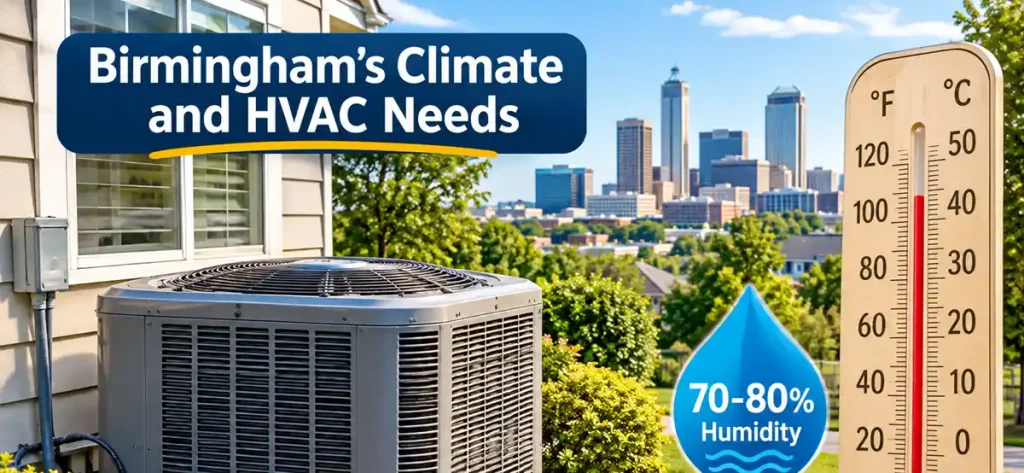
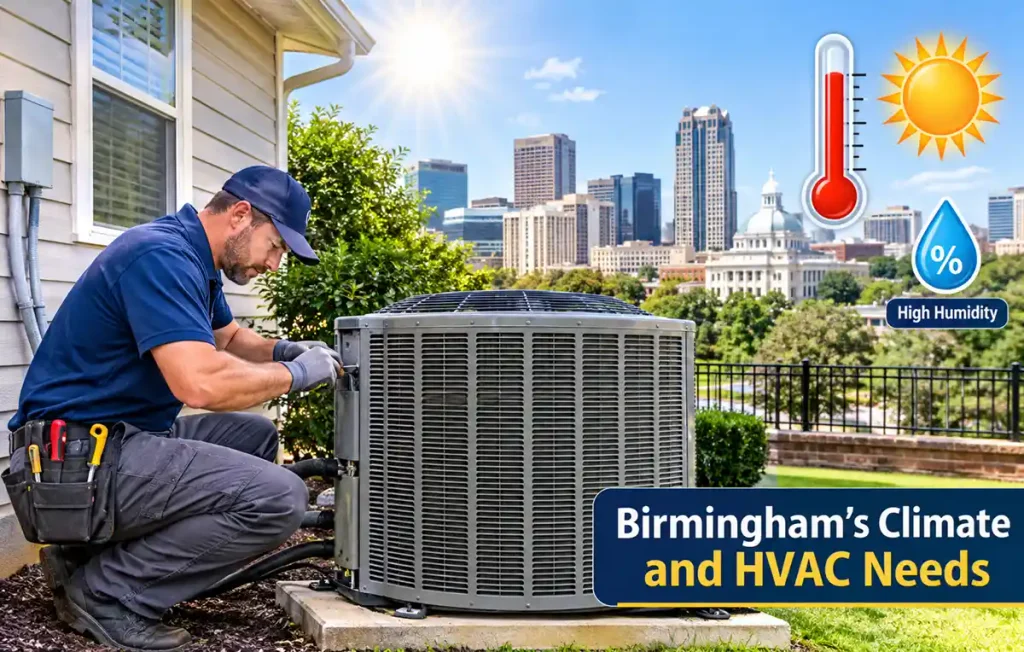
Birmingham’s climate puts more stress on cooling than on heating. July highs sit near 90°F, and dew points (the temperature where moisture condenses) regularly climb into the 70s. Winters are shorter, but January lows near freezing still test heat pumps and gas furnaces.
If you’ve spent a summer in Birmingham, you know the air feels heavy by 9 a.m. That moisture load is why runtime, coil temperature, and drain lines deserve as much attention as raw cooling capacity.
| Season | Typical Conditions | What Your System Does | Most Common Strain |
|---|---|---|---|
| Late Spring (Apr-May) | 70s-80s°F, rising humidity | First heavy cooling cycles | Dirty coils, clogged condensate drains |
| Summer (Jun-Sep) | Highs near 90°F+, dew points 70°F+ | Long runtimes, heavy dehumidifying | Capacitor failure, frozen coils |
| Fall (Oct-Nov) | Mild days, cool nights | Light cooling, first heat calls | Furnace igniter and flame sensor issues |
| Winter (Dec-Feb) | Lows near 30°F, short hard freezes | Heating, defrost cycles | Heat pump leaning on backup heat strips |
Local Housing Adds Another Layer
Housing stock varies widely across Jefferson, Shelby, and St. Clair counties. Older homes near downtown often have patched ductwork and limited return air. Newer subdivisions along I-65 and U.S. 280 tend to have attic air handlers running in 120°F+ attic heat.
On recent service calls across Jefferson County, the pattern repeats: leaky attic ducts lose cooled air before it reaches the rooms. Sealing ducts often fixes “hot bedroom” complaints that people blame on the AC itself. Start any comfort complaint by checking the filter and feeling the supply registers in each room.
Which System Types Work Best in Birmingham Homes
Four system types cover nearly every home in the region. Each one handles our humid summers and short cold snaps differently.
| System Type | How It Works | Best Fit | Typical Lifespan (Birmingham) |
|---|---|---|---|
| Central AC + Gas Furnace | AC cools; furnace burns natural gas for heat | Homes with existing gas lines | AC: 12-15 yrs; Furnace: 15-20 yrs |
| Heat Pump (Split) | Moves heat out in summer, in during winter | All-electric homes, mild winters | 10-15 yrs |
| Dual Fuel | Heat pump plus gas furnace backup | Homes wanting efficiency and strong winter heat | 12-18 yrs |
| Ductless Mini-Split | Outdoor unit feeds wall-mounted indoor heads | Additions, bonus rooms, older homes without ducts | 12-20 yrs |
Pros and Cons at a Glance
Heat pumps
- Pro: One system for both seasons, strong efficiency in our mild winters
- Pro: No combustion inside the home
- Con: Leans on electric backup heat during hard freezes, which raises the bill
Gas furnace + central AC
- Pro: Strong, fast heat on the coldest mornings
- Pro: Furnaces often outlast the AC paired with them
- Con: Requires annual venting and carbon monoxide safety checks
Ductless mini-splits
- Pro: Room-by-room control and no duct losses
- Con: Higher upfront cost per zone; indoor heads need regular filter cleaning
Match the system to your fuel source, duct condition, and how long you plan to stay in the home.
SEER2 Efficiency Standards for Alabama
SEER2 (Seasonal Energy Efficiency Ratio 2) measures cooling efficiency under updated test conditions that better reflect real ductwork. Since January 1, 2023, Alabama falls under the Southeast region rules, which set higher minimums for central air conditioners than northern states.
| Equipment | Federal Minimum (Southeast) | ENERGY STAR Threshold | What It Means for You |
|---|---|---|---|
| Split AC under 45,000 Btu/h (under ~3.75 tons) | 14.3 SEER2 | 15.2 SEER2 / 12.0 EER2 | Most Birmingham homes fall here |
| Split AC 45,000 Btu/h and up | 13.8 SEER2 | 15.2 SEER2 / 12.0 EER2 | Larger homes, 4-5 ton systems |
| Split Heat Pump | 14.3 SEER2 / 7.5 HSPF2 | 15.2 SEER2 / 8.1 HSPF2 | HSPF2 rates heating efficiency |
| Gas Furnace (non-weatherized) | 80% AFUE | 95%+ AFUE (South region guidance varies) | AFUE is the share of fuel turned into heat |
Higher ratings cost more upfront. The payback depends on how many hours your system runs, and in Birmingham, that is a lot of hours. Compare certified models and look up local rebates through ENERGY STAR’s rebate and product tools before you sign a quote.
The Refrigerant Shift Matters Too
New split systems now use A2L refrigerants such as R-454B and R-32. Existing R-410A equipment can still be serviced. Older R-22 systems are a different story: that refrigerant is no longer produced, so recharges are expensive and limited.
Check the data plate on your outdoor unit for the refrigerant type before you request any repair quote.
Birmingham Heating and Cooling Prices by Service
Birmingham heating and cooling prices depend on equipment age, access, part availability, and timing. An attic air handler costs more to service than a closet unit. A weekend emergency call costs more than a Tuesday morning visit.
The ranges below reflect typical Birmingham-area market pricing. Your final quote comes from the provider who inspects your system.
Diagnostic, Maintenance, and Common Repairs
| Service | Typical Price Range | Notes |
|---|---|---|
| Diagnostic / service call | $89-$175 | Often credited toward the repair |
| After-hours or emergency call | $150-$350 | Nights, weekends, holidays |
| Seasonal tune-up (per system) | $80-$175 | Spring for AC, fall for heat |
| Capacitor replacement | $150-$400 | Most common summer failure |
| Contactor replacement | $150-$350 | Often replaced with the capacitor |
| Condensate drain clearing | $100-$250 | Frequent in humid months |
| Furnace igniter replacement | $150-$400 | Common first-cold-night call |
| Flame sensor cleaning/replacement | $100-$250 | Fixes many “lights then shuts off” cycles |
| Condenser fan motor | $350-$800 | Outdoor fan stops spinning |
| Blower motor (standard/ECM) | $450-$1,500 | ECM (variable-speed) motors cost more |
| Refrigerant leak search + repair | $300-$1,800+ | Depends on leak location and refrigerant |
| Evaporator coil replacement | $1,500-$3,200 | Indoor coil, often from leaks |
| Compressor replacement | $1,800-$3,800 | Often triggers a replace-vs-repair talk |
Replacement and Upgrade Projects
The Birmingham heating and cooling cost for full replacement varies most with tonnage, efficiency rating, and duct condition.
| Project | Typical Installed Range | What Drives the Price |
|---|---|---|
| Central AC only (2.5-4 ton) | $5,500-$9,500 | SEER2 rating, coil match, line set |
| Gas furnace replacement | $3,500-$7,500 | 80% vs. 95% AFUE, venting changes |
| Full AC + furnace system | $8,500-$15,000 | Brand, efficiency, ductwork |
| Heat pump system | $7,000-$14,000 | Single-stage vs. variable-speed |
| Ductless mini-split (single zone) | $3,500-$6,500 | Line length, wall location |
| Ductless multi-zone (3-4 heads) | $9,000-$17,000 | Number of zones |
| Whole-home dehumidifier | $1,800-$3,500 | Ducted install, drain routing |
| Duct sealing / repair | $500-$2,500 | Attic access, extent of leaks |
| Smart thermostat install | $150-$450 | Wiring, C-wire availability |
Ask every provider for a written, itemized quote that lists equipment model numbers. You can review the full list of residential HVAC services to match your problem to the right type of visit before you call.
Repair or Replace: A Decision Framework
Replacement makes sense when repair costs climb and efficiency drops. The “$5,000 rule” gives you a quick starting point: multiply the system’s age by the repair cost. If the total tops $5,000, replacement deserves a serious look.
Example: a 13-year-old AC needing a $1,200 compressor-related repair scores 15,600. That points toward replacement.
| Factor | Lean Toward Repair | Lean Toward Replace |
|---|---|---|
| System age | Under 10 years | 12+ years (AC/heat pump), 18+ (furnace) |
| Repair cost | Under 25% of replacement price | Over 40-50% of replacement price |
| Refrigerant | R-410A with a small, fixable leak | R-22 or repeated leaks |
| Repair history | First major issue | Third repair in two seasons |
| Comfort | Even temps, normal humidity | Hot rooms, sticky air, short cycling |
| Energy bills | Stable year over year | Rising with no rate change |
| Safety | No combustion concerns | Cracked heat exchanger, CO alarms |
Steps to Make the Call
- Find the age. Check the outdoor unit’s data plate for the manufacture date.
- Get the repair quote in writing. Include parts, labor, and any refrigerant.
- Run the $5,000 math. Age times repair cost.
- Price a replacement. Ask for a Manual J load calculation, not a rule-of-thumb sizing.
- Compare 10-year costs. Add expected repairs and energy use to each option.
A cracked heat exchanger is never a “repair later” item. It can leak carbon monoxide, so treat it as an immediate replacement conversation.
Electrician Birmingham: What It Means for Your AC System
Common HVAC Problems in Birmingham Homes
Most service calls start with a symptom, not a diagnosis. Local technicians we work with frequently see the same handful of failures every summer and every first cold snap.
| Symptom | Likely Causes | Safe Homeowner Check | When to Call a Pro |
|---|---|---|---|
| AC blowing warm air | Failed capacitor, tripped breaker, outdoor fan stopped | Confirm Cool mode; check breaker and outdoor disconnect | Outdoor fan not spinning or unit humming |
| AC freezing up | Dirty filter, blocked return, low refrigerant | Turn system off, run fan only to thaw, replace filter | Ice returns within a day |
| Water near indoor unit | Clogged condensate line, cracked pan | Check the float switch and drain line opening | Water stains ceiling or recurs |
| AC won’t turn on | Dead thermostat batteries, float switch trip, failed board | Replace batteries; check breaker | No power at the air handler |
| Furnace not heating | Dirty flame sensor, failed igniter, filter | Replace filter; confirm furnace door is closed | Burners light then shut off repeatedly |
| Furnace blowing cold air | Fan set to On, ignition failure | Set thermostat fan to Auto | Cold air with burners never lighting |
| Heat pump “not heating” | Normal defrost cycle, backup heat fault | Wait 10 minutes for defrost to finish | Ice block stays on outdoor coil |
| Grinding or banging noise | Motor bearings, loose blower wheel | Turn system off | Any metal-on-metal sound |
When your AC runs but the vents feel warm, our symptom-by-symptom troubleshooting guides walk you through safe checks before you book a visit.
Steps to Troubleshoot an AC Blowing Warm Air
- Check the thermostat. Confirm it reads Cool and the setpoint is below room temperature.
- Inspect the filter. A clogged filter chokes airflow and can freeze the coil.
- Reset the breaker. Flip it fully off, then on. Do this once only.
- Look at the outdoor unit. The fan should spin and air should feel warm on top.
- Clear debris. Pull grass clippings and leaves at least 2 feet away from the coil.
- Stop and call. If the unit hums without the fan spinning, the capacitor is a likely culprit.
Never open the electrical panel on your outdoor unit. Capacitors hold a charge even with the power off.
Indoor Air Quality and Humidity Control
Humidity control drives comfort in Birmingham more than any thermostat setting. The EPA recommends keeping indoor humidity between 30% and 50%. Above 60%, you invite mold, dust mites, and that clammy feeling at 74°F.
Our cooling experts notice one mistake above all: running the thermostat fan on On. That setting blows moisture off the wet coil right back into the house. Switch to Auto and humidity often drops several points within days.
| Solution | What It Does | Typical Cost | Best For |
|---|---|---|---|
| MERV 8-11 filter | Captures pollen, dust, pet dander | $10-$40 per filter | Most homes |
| Whole-home dehumidifier | Removes moisture independent of cooling | $1,800-$3,500 | Basements, tight new homes |
| Variable-speed blower | Longer, slower runs that pull more moisture | Part of system upgrade | Homes with chronic stickiness |
| Duct sealing | Stops humid attic air entering returns | $500-$2,500 | Attic duct systems |
| Fresh air ventilation (ERV) | Brings in outside air with less moisture load | $1,500-$3,500 | Very airtight homes |
Signs Your Home Has a Humidity Problem
- Condensation on windows during summer mornings
- Musty odors in closets or bonus rooms
- Cool but clammy air at your normal setpoint
- Mold spots on supply vents or bathroom ceilings
Buy a $15 hygrometer and track indoor humidity for one week before paying for any air quality upgrade.
Seasonal Maintenance Checklists
Two tune-ups a year prevent most emergency calls. Schedule cooling service in March or April and heating service in October.
Spring Cooling Checklist (Before Memorial Day)
- Replace the filter (every 1-3 months in summer)
- Rinse the outdoor coil gently with a garden hose, top to bottom
- Clear 2 feet of space around the condenser
- Flush the condensate line with a cup of vinegar
- Test the thermostat by dropping the setpoint 5°F
- Book a pro tune-up for refrigerant, capacitor, and electrical checks
Fall Heating Checklist (Before the First Freeze)
- Replace the filter
- Test carbon monoxide detectors on every level
- Run the heat on a mild day to burn off dust
- Clear the outdoor heat pump of leaves and pine straw
- Book a pro tune-up for heat exchanger, flame sensor, and backup heat checks
| Task | DIY or Pro | Frequency |
|---|---|---|
| Filter replacement | DIY | 1-3 months |
| Condensate line flush | DIY | Every 3 months in summer |
| Coil cleaning (deep) | Pro | Yearly |
| Refrigerant and electrical test | Pro | Yearly (spring) |
| Combustion and CO safety check | Pro | Yearly (fall) |
| Duct inspection | Pro | Every 3-5 years |
Put both tune-up dates on your calendar today so they land before the busy season.
Air Conditioning Repair Birmingham AL: Save on Every Fix
Reading Company Reviews Before You Hire
Reviews reveal how a company handles problems, not just how friendly the tech was. Read the 3-star reviews first. They show where things go wrong and how the company responded.
One search trap deserves a warning. People who look up Birmingham Plumbing, Heating & Cooling company reviews often land on a business in Birmingham, Michigan, not Alabama. Searches for birmingham’s heating and cooling ltd frequently surface UK-style listings. Always confirm the city, state, and phone area code (205 or 659) before trusting a review score.
| What to Check | Green Flag | Red Flag |
|---|---|---|
| Alabama license | Number listed and verifiable | Won’t share a license number |
| Review volume and recency | Steady reviews from the past 6 months | Burst of reviews in one week |
| Owner responses | Calm, specific replies to complaints | No replies or defensive replies |
| Pricing mentions | “Quoted upfront, no surprises” | Repeated “final bill was higher” |
| Diagnosis accuracy | “Fixed it the first visit” | Multiple return trips for one issue |
| Sales pressure | Repair options explained | “Replace today or lose the deal” |
Questions to Ask on the Phone
- Ask for the license number. Verify it with the Alabama Board of Heating, Air Conditioning and Refrigeration Contractors.
- Ask about the diagnostic fee. Confirm whether it applies to the repair.
- Ask for a written quote. Get model numbers for any new equipment.
- Ask about warranties. Separate parts coverage from labor coverage.
- Ask about load calculations. Any replacement quote should include a Manual J.
At HVAC Service Birmingham, one call connects you with an independent local provider for your address. You can learn how it works on the HVAC Service Birmingham home page.
Service Areas Across Central Alabama
Local knowledge matters for Birmingham heating and cooling work. A lake home near Pell City faces different moisture issues than a new build in Chelsea or a 1940s bungalow in Birmingham.
| County | Communities | Common Local Factors |
|---|---|---|
| Jefferson County | Birmingham, Trussville, Gardendale, Fultondale, Pinson, Mount Olive | Older ductwork, hillside homes, mixed gas and electric |
| Shelby County | Pelham, Alabaster, Chelsea, Vandiver, Sterrett, Westover | Newer subdivisions, attic air handlers, larger tonnage |
| St. Clair County | Pell City, Leeds, Moody, Odenville, Springville, Riverside, Cropwell, Steele | Lake homes, crawlspace humidity, rural access |
| Chilton County | Clanton | Rural properties, longer service drives |
| North Alabama | Bremen, Moulton | Coverage confirmed on the call |
You can browse all 23 towns and communities in our coverage to confirm your address before you call.
Birmingham Heating and Cooling FAQs
Why does my AC run almost nonstop in August?
Long runtimes are normal when outdoor temps pass 95°F with high humidity. A properly sized system runs longer cycles to pull moisture. The concern is a system that runs nonstop and still can’t hold 78°F. That points to low refrigerant, a dirty coil, or leaky attic ducts.
Should I switch my heat pump to “Emergency Heat” during a January freeze?
No. Emergency heat runs only the electric strips and can double your heating cost. Your heat pump brings on backup heat automatically when needed. Use emergency heat only if the outdoor unit has failed.
Does a bigger AC cool better in Birmingham humidity?
No. An oversized AC cools the air fast and shuts off before it removes moisture. The result is a cold, clammy house. Proper sizing through a Manual J load calculation gives you better comfort than extra tonnage.
Can I still repair my R-410A system now that new units use A2L refrigerants?
Yes. R-410A remains available for service. Refrigerant prices have risen, though, so a large leak on an older unit may tip the math toward replacement.
What’s the best time of year to replace a system in Birmingham?
March-April and October-November. Demand drops, scheduling opens up, and you avoid making a five-figure decision during a heat wave.
How much does Birmingham heating and cooling cost per year for a typical home?
Plan for two tune-ups ($160-$350 combined), filters ($60-$200), and a repair reserve of $200-$500 for systems over eight years old. Energy costs vary most with SEER2 rating, duct condition, and thermostat habits.
What indoor humidity should I target in summer?
Aim for 45% to 50%. If your hygrometer reads above 55% with the AC running, have your airflow, fan setting, and system sizing checked.
Your Next Step
Strong Birmingham heating and cooling performance comes down to three things: correct sizing, controlled humidity, and maintenance before the season hits. Know your system’s age, refrigerant type, and SEER2 rating before you request any quote.
Check your filter, set the thermostat fan to Auto, and read your outdoor unit’s data plate this week. Then call with those details in hand so the provider can give you a faster, more accurate answer.
Need help with heating or cooling in Birmingham or nearby?
CALL NOW